


How to Understand Trading Strategy Backtest Results
We analyze how to properly read backtest results in trading: equity curve, drawdown, win rate, and key metrics for strategy evaluation.
How to Read Backtest Results in Trading
Automated trading requires a strict mathematical approach. Now traders and investors use trading bots, indicator systems, and ready-made algorithms, but the question will always remain relevant: does such a strategy work over the long haul? A backtest provides the answer. It is important to understand that backtest results alone do not guarantee success. It is much more important to read and interpret them correctly. Understanding how to read backtest results helps distinguish a sustainable trading idea from a random set of trades.
What is a Backtest and Why is it Important
A backtest is a verification of a trading strategy using historical data. The algorithm virtually executes trades in the past, using your specified entry filters, order grid, and take-profit settings.
The value of testing:
- Safety. Assessing the viability of an idea without risking real money.
- Error Correction. Identifying weak points in the algorithm before launch.
- Market Phase Analysis. Understanding in which conditions (trend, flat) the strategy is most effective.
However, remember: a backtest shows the past, it does not predict the future. Special attention should be paid to the details of the report, not just the final profit figure.
Key Backtest Metrics
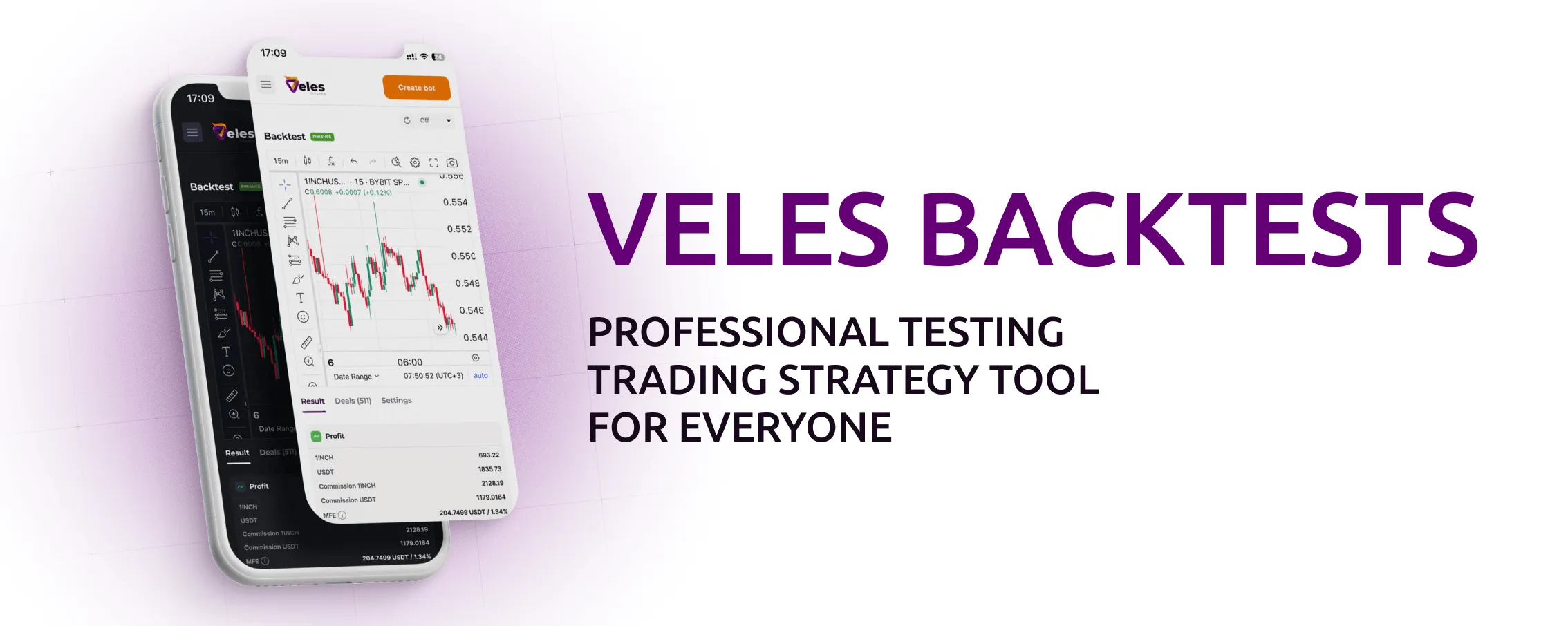
To properly evaluate a strategy, you need to understand the indicators that the platform displays in the “Result” tab and in the report header.
Profitability and Return
The absolute value of profit (in USDT) without context says little. It is much more important to look at the dynamics.
To do this in Veles, go to the “Charts” tab and study the Cumulative Profit. A smooth upward line indicates stable strategy performance. Sharp spikes and long horizontal sections may signal increased risks or the dependence of the result on a couple of random successful trades.
Also, pay attention to the duration of the test. Profit obtained in a couple of days may turn out to be unstable over a distance of a month or a quarter.
Risks and Volatility
Profitability should always be considered together with risks. In the Veles interface, the key risk indicator is MFL (Max Floating Loss), which is displayed in the top panel of the report.
MFL shows how much the balance dipped at the moment relative to the fixed profit. The higher the MFL value (in percent), the more difficult it is psychologically and financially to withstand such trading.
Low MFL with moderate profit is often preferable to an aggressive strategy with high returns but deep drawdowns. For automated trading, this balance is critical, as bots work around the clock. If MFL approaches critical values, there is a high risk of liquidation or stop-loss when market conditions change.
Trade Efficiency
The quality of the algorithm’s work is reflected by indicators in the statistics widgets. One of the most popular is Winrate, that is, the percentage of successful trades out of the total number.
A high Winrate (for example, 95-100%) does not always mean an ideal strategy. The bot can close many small trades in profit, but one large failure will cancel out the entire result.
Consider Winrate together with the “Average Trade” indicator. This will help you understand the real mathematical expectation of your trading. Also, evaluate the total number of trades. A sample that is too small (for example, less than 10 trades) reduces the statistical significance of the test and makes the indicators unreliable.
How to Interpret Results
The figures in the report do not give a ready-made answer by themselves. The trader’s task is to evaluate the logic and stability of the configuration.
Action algorithm in the Veles interface:
- General Picture Analysis. Open the “Charts” tab. Evaluate how the strategy earns over distance. A smooth movement of the cumulative profit line upwards indicates consistency. Sharp vertical take-offs are a sign of randomness or extreme risk.
- Drawdown Assessment (MFL). Look at the MFL value in the header. Correlate it with potential profit. A strategy with 10% profit and 50% MFL is extremely dangerous.
- Trade Structure. Go to the “Trades” tab. Study the history of executed orders. Pay attention to how often safety orders were triggered. If the bot regularly picks up the entire grid volume, this is a signal that the coverage settings need to be revised.
- Stability. If the strategy shows a good result only on one coin or in a narrow time interval, its reliability is questionable. Robust algorithms demonstrate similar characteristics in different markets.
By conducting this check-up, you move from blind faith in numbers to conscious risk management. If at least one of the listed points causes doubt, the strategy should be sent for revision: it is better to spend extra time on tests in Veles than to lose part of the deposit in real trading.
Common Mistakes When Reading Backtests
Even a high-quality tool can be misleading if used incorrectly. Avoid the following mistakes:
- Evaluating only by profit. A large “Profit” figure in green creates an illusion of reliability. Without taking MFL into account, such results have no practical value. High profitability with a huge floating loss will sooner or later lead to the loss of the deposit.
- Ignoring the profit chart. Many limit themselves to numbers, missing visualization. The cumulative profit chart often says more about the strategy than dry statistics. A chaotic curve requires additional verification of settings.
- Overestimating Winrate. An indicator of 100% successful trades looks attractive but often hides the risk of “sitting out” losses. The balance between average profit and average loss is more important.
- Short distance. A test for 3 days or a week does not reflect the real picture. Positive results in a small segment are often accidental. Use data for at least a month to capture different market conditions.
- Ignoring trading commissions. In Veles backtest settings, always take exchange commissions into account. In reality, even small costs can significantly reduce the final profitability with frequent trading. You need to specify it only once, then it will be saved.
Excluding these errors will help you see the real effectiveness of your configuration. Remember that a high-quality backtest should not so much promise super profits as morally and technically prepare you for possible market behavior scenarios, protecting against inflated expectations.
How to Use Backtests in Veles Finance
Veles provides professional tools for in-depth work with strategies.
- Functionality. You can run backtests for spot and futures, choosing any popular exchanges and timeframes.
- Visualization. The “Charts” and “Trades” tabs allow you to analyze each entry and exit from a position in detail.
- Marketplace. You can study ready-made strategies in the Veles Marketplace, analyze their statistics, and adapt them to your own goals.
Before launching a real bot, be sure to conduct testing on historical data. This is not a formality, but a necessary stage that reduces risks and increases the chances of stable trading. Use Veles backtesting tools as a basis for your decisions.
FAQ
Can a backtest be considered a guarantee of future profits? A backtest does not guarantee profitability. It only shows how a strategy performed in the past, as the market is constantly changing. Backtest results help evaluate the logic and stability of an algorithm, not predict its future behavior.
What backtest metrics should I look at first? The most important thing is to analyze profitability in relation to risk. The final profit, equity curve, and drawdown provide a general understanding of how a strategy earns and what drawdowns it experiences. Without this, the figures lose their practical value.
Why doesn’t a high win rate always indicate a good strategy? The percentage of profitable trades reflects only the frequency of success, not their quality. A strategy can have a high win rate and still lose money due to rare but large losses. The ratio of average profit to average loss is much more important.
How much data is needed for a reliable backtest? The longer the testing period and the more trades, the higher the statistical significance of the results. A short backtest or a small sample often distorts the true picture and creates the illusion of a strategy’s effectiveness.
Why consider market phases when analyzing a backtest? Strategies perform differently in trends, sideways movements, and high volatility. If an algorithm only shows good results in one market type, its sustainability is questionable. Market phase analysis helps identify the true strengths and weaknesses of a strategy.