


Trading Synthetic Stocks on Bitget: 5 Ready Veles Algorithms
By 2026, the gap between digital assets and the traditional exchange has disappeared. The platform went all-in: it opened mass trading, and now trading synthetic stocks on Bitget via USDT futures is available to everyone. Shares of the largest technology corporations are traded absolutely freely, and all the advantages of automation apply to them. The Veles Finance team studied this new direction, transferred stock indicators to the crypto market, ran tests, and assembled five fully configured bots.
What you will learn:
- What are Bitget synthetic stocks? This is an instrument that allows you to speculate on the price movements of stocks (TSLA, MSTR, etc.) via derivatives. You do not own the stock itself.
- Are these tokenized stocks? No. The article describes trading via USDT stock futures, which have a different risk model.
- Is 24/7 trading available? Yes, derivatives on crypto exchanges are traded without strict adherence to traditional market sessions.
- Do I need leverage? No. The tests below were conducted without leverage (x1). Leverage increases the risk of liquidation.
- How to reduce risks? Limit your leverage, monitor the floating loss (Max DD), and be sure to use trading strategy backtesting.
- How to launch ready-made Veles bots? Register on the exchange, create an API key without withdrawal rights, connect to Veles (guide in Wiki), and copy the template.
S&P 500 looks into the abyss: why algorithmic stock trading is profitable
Local trades in a vacuum are doomed. The global S&P 500 chart in 2026 has run out of steam and is preparing for a hard landing. Buying and holding stocks against such a backdrop is dangerous. But this is exactly where the main trump card of derivatives — their maneuverability — is revealed.
You earn on short bounces within a falling trend and insure your capital against sudden crashes. Keep an eye on the drawdown and the time in a trade. If a bot accumulates a position, and the asset plummets to the bottom along with the market, clear risk management is needed: a manual exit or a strict protective order. The exchange does not forgive blind faith in eternal growth.
Modest percentages or real statistics?
In the tests below, you will see a profit of 1.5–6% per quarter. To fans of aggressive crypto trading, this may seem like little. But we are talking about the stock market.
Making 6% on conservative stocks in 3 months without leverage, with minimal drawdown and fully automated, is a result for which massive bonuses are paid on Wall Street. Stock futures are not about gambling, but about stable and safe capital multiplication.
Ready-made Veles bots for stock trading
1. TSLA || RSI Bora Bot
Tesla (TSLA) shares are famous for sharp squeezes. The classic approach works here. The Relative Strength Index (RSI) perfectly captures oversold moments when the crowd panics and dumps the stock.
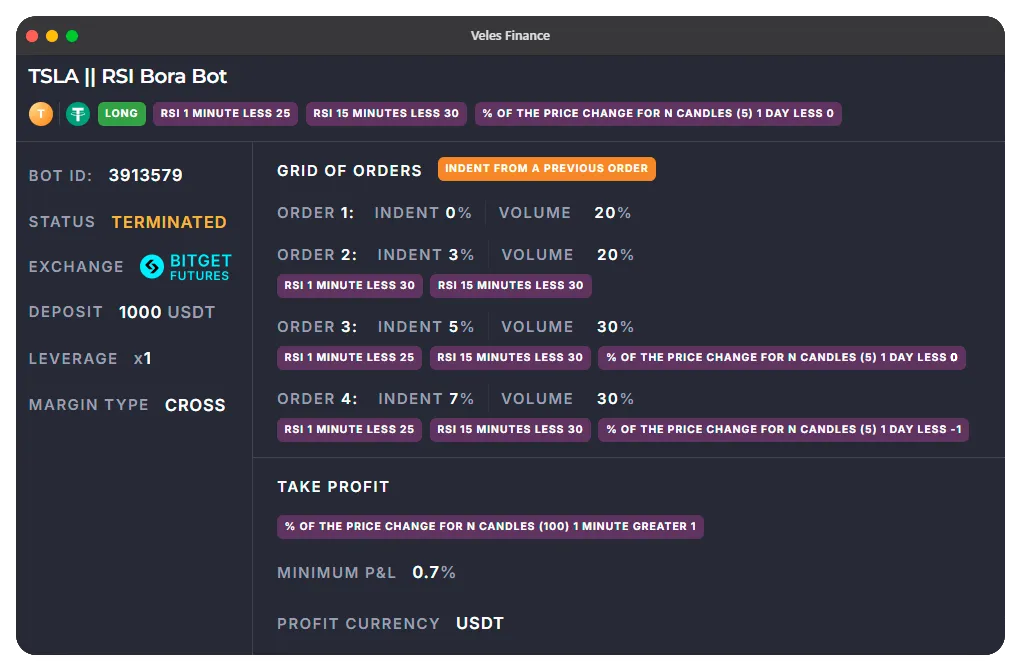
Max time in trade (per quarter): 8 days
Number of entries: 22
Net profit (without leverage): +2.11%
Maximum drawdown: -4.38%
Do not expect x’s here. This is a conservative capital parking with minimal risk and a high probability of execution.
2. MSTR || ROC Digital Bot
MicroStrategy (MSTR) is Bitcoin on steroids. The stock moves aggressively and widely. The Rate of Change (ROC) indicator measures the asset’s momentum, allowing the bot to enter a trade at the moment the drop is exhausted.
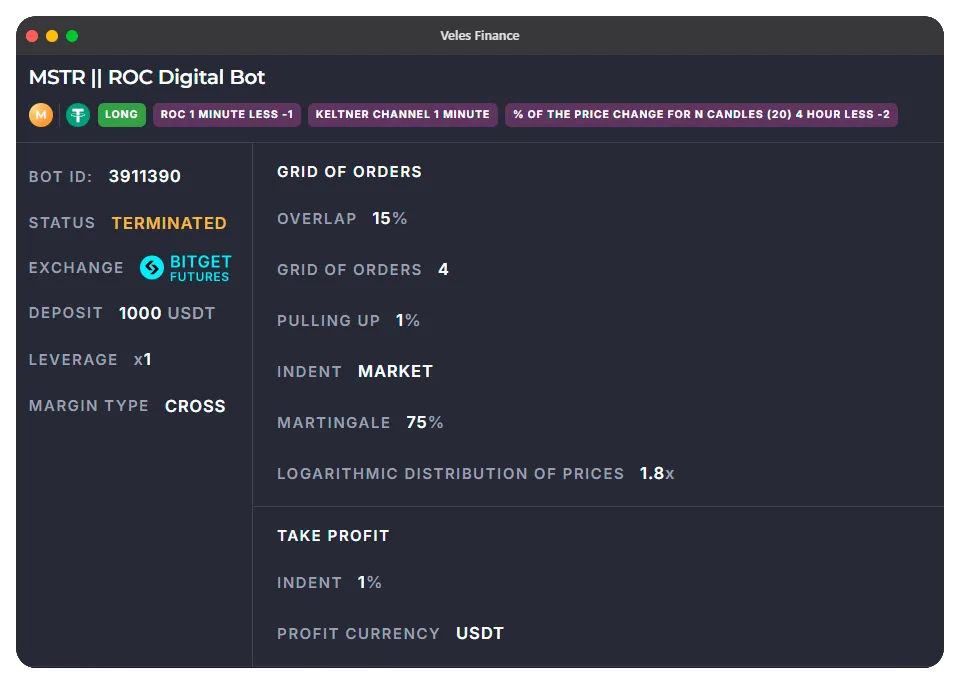
Max time in trade (per quarter): 6 days
Number of entries: 25
Net profit (without leverage): +5.83%
Maximum drawdown: -16.54%
The most profitable but also the most volatile bundle from the selection. Requires nerves of steel and margin reserve.
3. AMZN || ADX Respo Bot
Amazon (AMZN) is a sluggish giant. The Average Directional Index (ADX) is embedded in the bot’s filters to assess the strength of micro-trends. The bot ignores flats and only turns on when a directional force appears in the market.
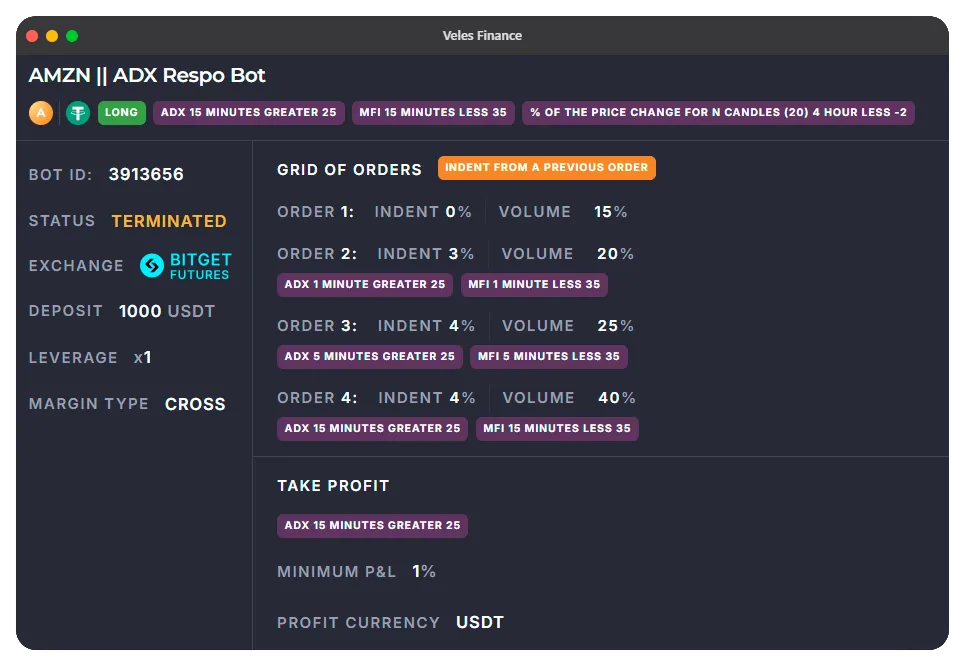
Max time in trade (per quarter): 6 days
Number of entries: 15
Net profit (without leverage): +1.57%
Maximum drawdown: -2.33%
The perfect choice for those who prioritize safety over profitability. A drawdown of just 2.3% is at the level of a bank deposit, but with greater liquidity.
4. NVDA || RVI Gent Bot
Nvidia (NVDA) dictates the rules of the tech sector. The Relative Vigor Index (RVI) is tuned to capture the hidden energy of price movement. The algorithm works proactively, leaving classic oscillators behind.
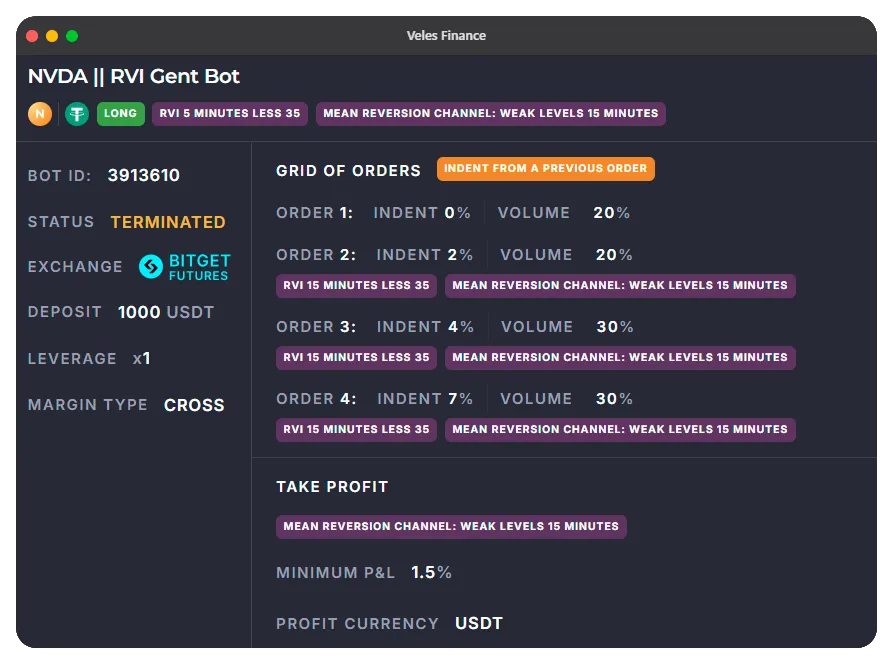
Max time in trade (per quarter): 3 days
Number of entries: 26
Net profit (without leverage): +1.83%
Maximum drawdown: -4.51%
Here you have quick iterations, a moderate number of entry points, and an extremely low floating loss (Max DD).
5. HOOD || ATR% Found
Robinhood (HOOD) shares have unique specifics. Their chart entirely depends on the sentiment of retail investors. The bot uses the Average True Range (ATR) to continuously adapt the order grid to the current width of the price channel.
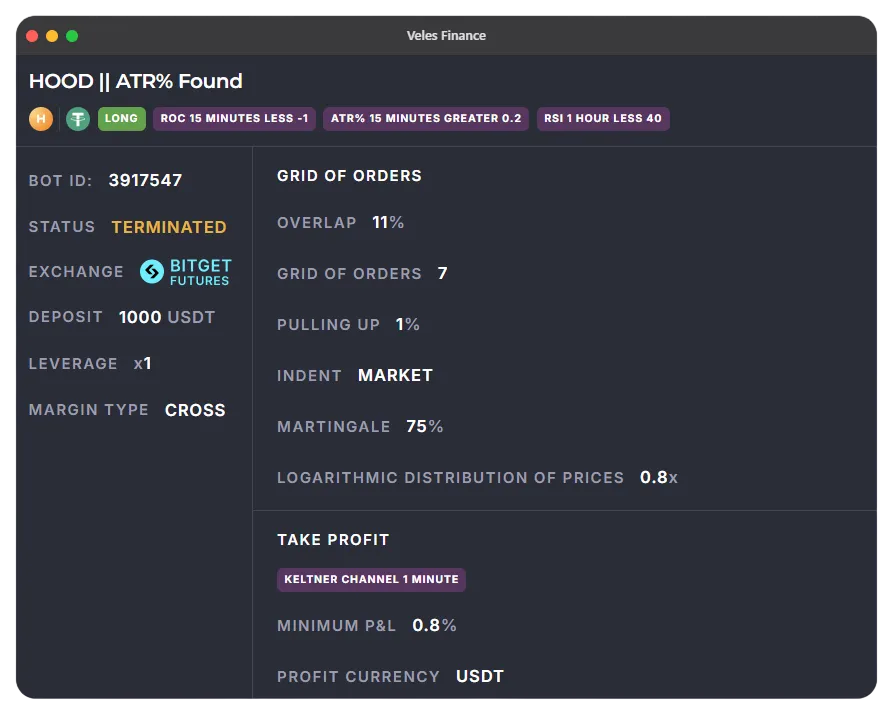
Max time in trade (per quarter): 7 days
Number of entries: 38
Net profit (without leverage): +3.01%
Maximum drawdown: -3.39%
A brilliant ratio of the number of trades to the final profit. The lowest drawdown from the entire list makes this algorithm phenomenally stress-resistant.
Summary
We have prepared all the necessary infrastructure for you: historical testing results, transparent drawdown metrics, and entry logic. Connect your API (a detailed guide is available in Veles Wiki), copy the templates, and use synthetic stocks to diversify your crypto portfolio.