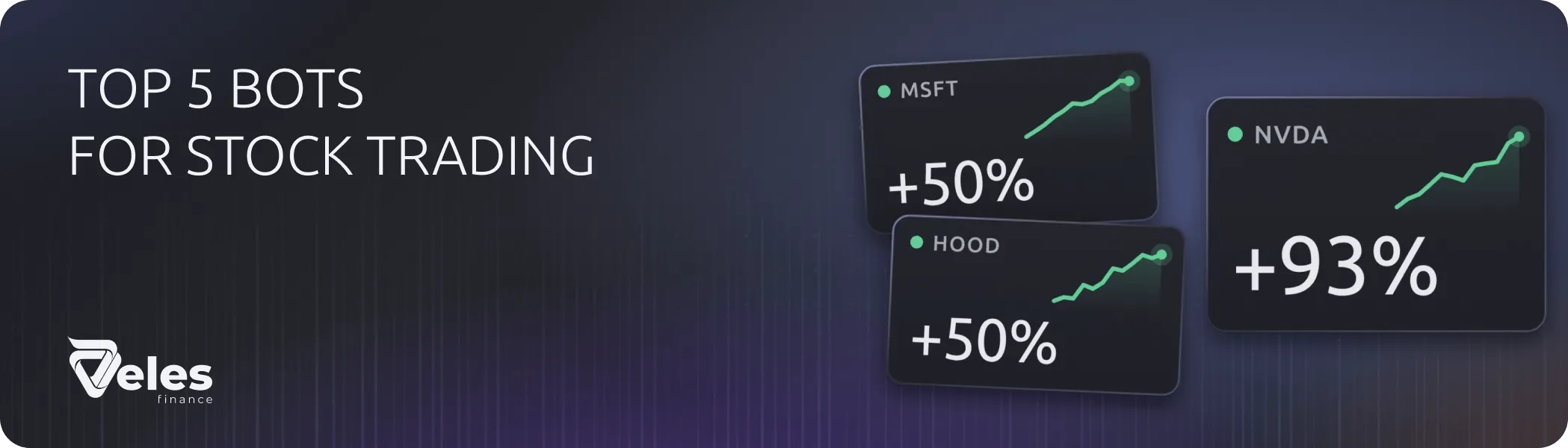
Can you buy Nvidia or Tesla stock if your broker won’t sell it to non-qualified investors? You can buy a stock token on a crypto exchange for USDT — or not buy the stock at all and run a bot instead. Over nine months, five Veles stock bots earned more than buying the same shares would have, and the Tesla bot finished in profit even though the stock fell. Below you’ll learn what tokenized stocks are, where to buy them, how tokens differ from stock futures, and what risks a token holder takes on. Closer to the end we give the Veles rule: how much money to keep on the exchange for stock bots.
Trading bots on stocks: results of 5 Veles bots
| Stock | Bot | Leverage | Net profit | MAE to deposit | Trades | How the stock price changed |
|---|---|---|---|---|---|---|
| NVDA (Nvidia) | NVDA LONG HL BOT | x3 | +93% | 22% | 127 | +24% |
| MSFT (Microsoft) | MSFT LONG HL BOT | x3 | +50% | 21% | 53 | +8% |
| HOOD (Robinhood) | HOOD HL BOT | x3 | +50% | 23% | 203 | −5% |
| MSTR (Strategy) | MSTR || ROC DIGITAL BOT | x2 | +41% | 17% | 123 | barely changed |
| TSLA (Tesla) | TSLA HL BOT | x5 | +41% | 15% | 36 | −10% |
How to read the table
- Net profit — the bot’s earnings after exchange fees, as a percentage of the deposit: 300 USDT on Bitget and 300 USDC on Hyperliquid.
- MAE to deposit — maximum unrealized loss: the biggest minus on an open trade over the period, as a percentage of the deposit.
- How the stock price changed — how much someone who bought the stock at the start of the period and sold it at the end would have earned or lost. We took the data from Veles backtests: it’s the price of the stock future on the same exchange.
We tested the bots on one-minute candles from December 31, 2025 to October 8, 2026. The MSTR bot trades on Bitget, the other four bots — on Hyperliquid. All bots use cross margin and have no stop-loss. Not a single trade closed at a loss. The NVDA, MSTR, and HOOD bots finished the test with an open trade, the unrealized loss on each around 1% of the deposit or less.
What tokenized stocks are
Tokenized stocks are instruments on a crypto exchange or in a blockchain whose price mirrors the price of a stock. You trade them in stablecoins — USDT or USDC — and don’t open a brokerage account. Stock tokenization is the issuance of such instruments.
On crypto exchanges the term covers two different instruments:
- Stock-backed tokens. An issuing company buys the stock, holds it with a custodian — an organization responsible for the safekeeping of securities — and issues tokens in a 1 ratio. An example is xStocks.
- Stock futures. An exchange or a third-party team creates a perpetual future — a contract on the stock price with no settlement date. There are no real shares behind the contract: you receive or pay the price difference. Bitget calls such contracts synthetic stocks.
Tokenized assets is a broader concept. Besides stocks, bonds, gold, real estate, and funds are tokenized too. Tokens backed by real assets are called RWA (real-world assets) — real assets on the blockchain. We covered RWA in the article “RWA in cryptocurrency”.
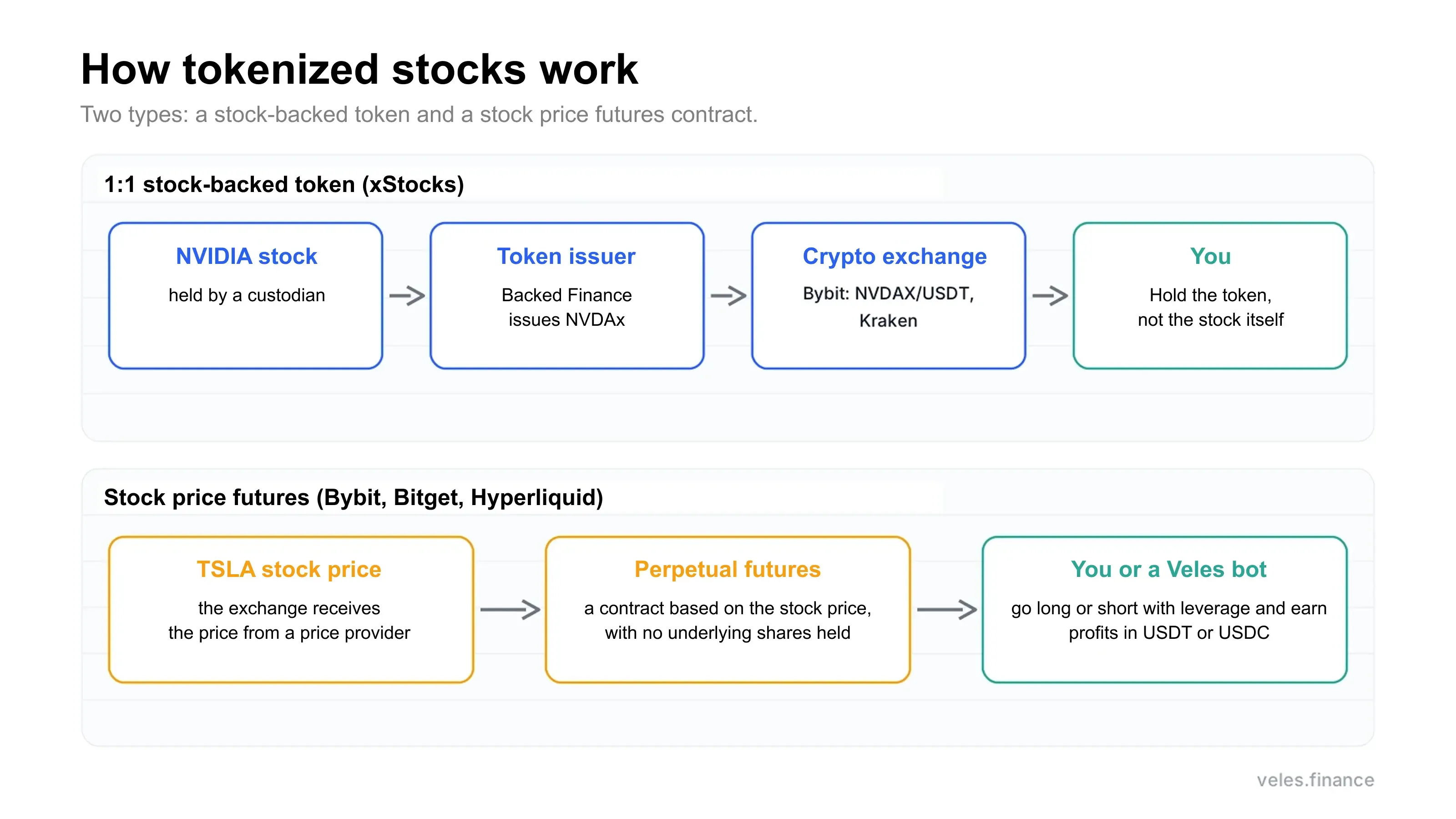
Bybit offers one more instrument — stock CFDs, contracts for difference in MetaTrader 5. We compared all three instruments in a table.
| xStocks tokens | Perpetual stock futures | Stock CFDs in MT5 | |
|---|---|---|---|
| What you buy | A token backed by a stock 1 | A contract on the stock price | A contract for difference |
| Where they trade | Bybit (spot), Kraken | Bybit, Bitget, Hyperliquid | Bybit: MT5, app, and website |
| Leverage | None | Bybit — up to x10, Bitget — up to x25, Hyperliquid — up to x20 on NVDA | Up to x5 |
| Short trade | No | Yes | Yes |
| When they trade | Bybit — around the clock, no days off; Kraken — 5 days a week | Bybit — no days off, Bitget and Hyperliquid — 5 days a week | On the US exchanges’ schedule |
xStocks: what the NVDAx and TSLAx tokens are
xStocks are tokens of stocks and exchange-traded funds issued by the company Backed Finance. In December 2025 the crypto exchange Kraken announced the acquisition of Backed. By early December 2025 Backed had issued 71 tokens, each backed by a security 1
. The token ticker is the stock ticker with the letter x: NVDAx — Nvidia, TSLAx — Tesla, AAPLx — Apple, SPYx — the S&P 500 index fund.Before buying, keep in mind:
- You don’t become a shareholder. A token holder has claims against the issuer but no voting right at the shareholders’ meeting.
- Dividends don’t come as cash. According to Bybit, the issuer reinvests dividends or changes the price or number of tokens.
- Bybit doesn’t exchange tokens for stock. Backed issued part of the xStocks tokens on the Solana network, and you can withdraw these tokens from the exchange to a Web3 wallet.
Where to buy tokenized stocks
Tokenized US stocks trade on Bybit, Bitget, Hyperliquid, and Kraken. Veles bots work with the first three exchanges.
Bybit. xStocks trade on Bybit’s spot market. Bybit writes the ticker in capital letters: find the NVDAX/USDT pair and buy the token like a regular coin. Bybit requires identity verification. Besides spot, Bybit offers perpetual stock futures and CFDs. It classifies both products as TradFi — short for traditional finance: that’s what crypto exchanges call sections with traditional assets — stocks, metals, oil, and currencies.
- Perpetual stock futures (Bybit launched them in May 2026 under the name TradFi perpetuals) — contracts in USDT on US stocks, gold, silver, oil, and ETFs, with leverage up to x10 and no-days-off trading. In May 2026 Bybit offered 20 such stock contracts, among them NVDA, TSLA, MSFT, MSTR, and HOOD.
- CFDs via MetaTrader 5. In July 2026 Bybit renamed the Bybit TradFi product to Bybit CFD, while the TradFi section in the app remained. You open a separate account in the TradFi → CFD section, transfer USDT to it, and trade in MT5, in the app, or on the Bybit website. Leverage on stocks is up to x5, and trading follows the US exchanges’ schedule.
Bitget launched stock futures in July 2025. By November 2025 Bitget offered more than 30 US stock contracts in USDT with leverage up to x25. We gathered bots for these contracts in the article “Bitget synthetic stocks”.
Hyperliquid is a decentralized exchange: an account is created through a Web3 wallet or by email. Since October 2025 third-party teams have launched their own markets on Hyperliquid, and the largest of them — trade.xyz — opened futures on NVDA, TSLA, MSFT, HOOD, and other stocks. Margin and profit are in USDC. Trading runs from Sunday evening to Friday evening New York time. We covered the exchange in the article “Veles × Hyperliquid”.
How to buy Tesla, Nvidia, Apple, and Microsoft stock on a crypto exchange
On a crypto exchange you have two options: buy an xStocks token or open a perpetual future on the stock price. Below we compare stock prices over the period from December 31, 2025 to October 8, 2026 using Veles backtest data.
How to buy Tesla stock (TSLA)
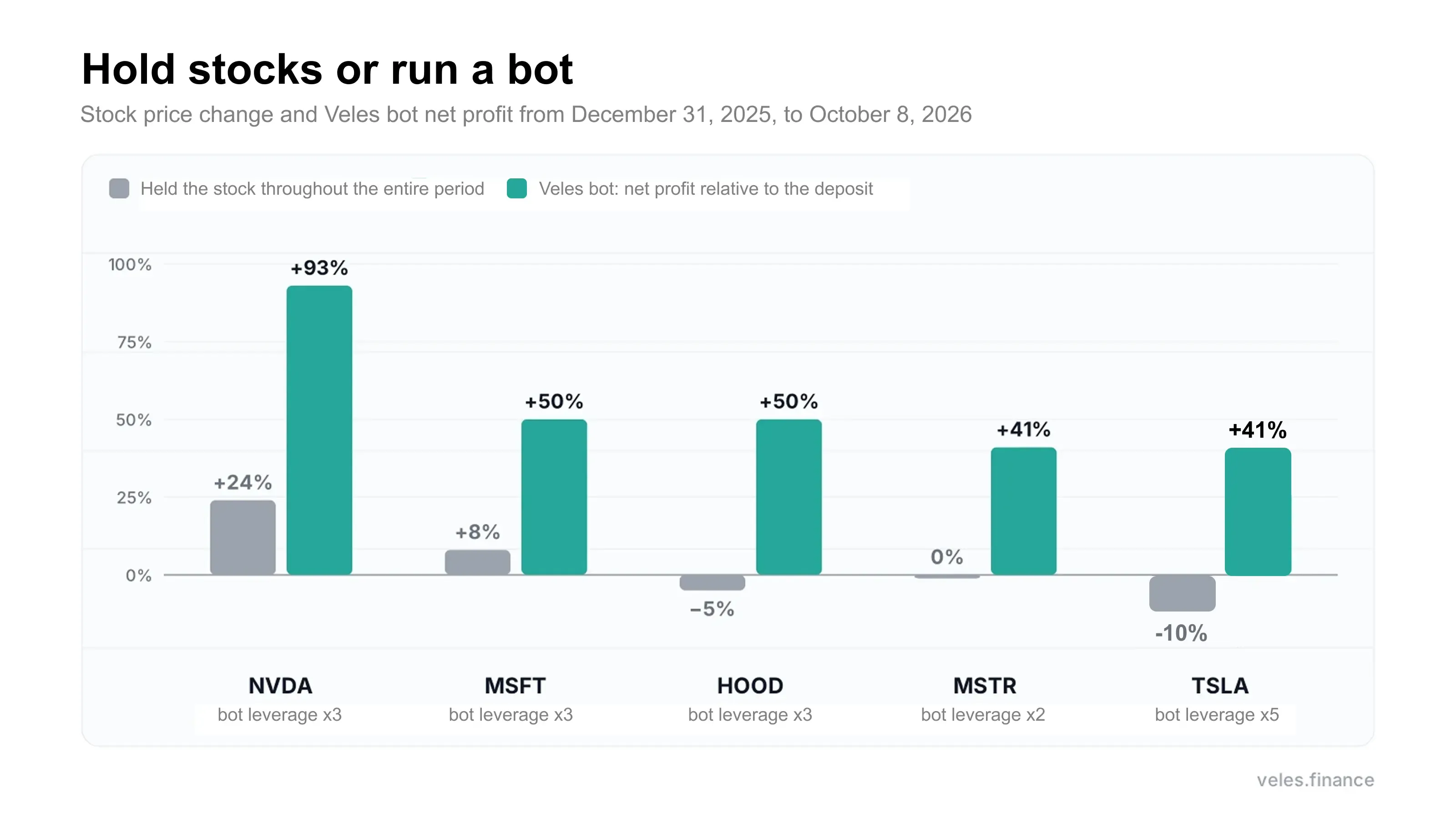
The Tesla token is TSLAx, on Bybit the pair is TSLAX/USDT. Tesla futures are available on Bybit, Bitget, and Hyperliquid. Over the period Tesla stock fell 10%, while the Tesla bot earned 41%.
Nvidia stock (NVDA)
The Nvidia token is NVDAx, on Bybit the pair is NVDAX/USDT. Nvidia futures are available on Bybit and Hyperliquid. Nvidia stock rose 24%, the Nvidia bot earned 93%.
How to buy Apple stock (AAPL)
The Apple token is AAPLx, on Bybit the pair is AAPLX/USDT. Apple futures are available on Bybit and Hyperliquid. There is no Apple bot in the selection.
Microsoft stock (MSFT)
The Microsoft token is MSFTx. Microsoft futures are available on Bybit and Hyperliquid. Microsoft stock rose 8%, the Microsoft bot earned 50%.
MicroStrategy stock (Strategy, MSTR)
MicroStrategy changed its name to Strategy in 2025, the ticker stayed the same — MSTR. The token is MSTRx. MSTR futures are available on Bybit and Bitget. The stock price barely changed over the period, while the MSTR bot on Bitget earned 41%.
Robinhood stock (HOOD)
The Robinhood token is HOODx. Robinhood futures are available on Bybit and Hyperliquid. Robinhood stock fell 5%, the Robinhood bot earned 50%.
OpenAI and Anthropic stock: what pre-IPO futures are
Pre-IPO is the stage when a company hasn’t gone public yet and its shares can’t be bought on the open market. On crypto exchanges a retail investor can trade a contract on such a company’s valuation — a pre-IPO future.
Binance launched the first pre-IPO future on SpaceX. In May 2026 the exchange added the OPENAIUSDT contract, and on June 2 — ANTHROPICUSDT with leverage up to x20. Before the IPO the contract price moves along with the company’s public valuations, for example with the announced offering price range. After the IPO the contract price mirrors the stock price.
- SpaceX went public on Nasdaq on June 12, 2026 under the ticker SPCX.
- OpenAI postponed its IPO: on September 29, 2026 Sam Altman announced the delay and didn’t name a new date.
- Anthropic filed a confidential IPO registration with the SEC on June 1, 2026. As of mid-October 2026 the company’s shares are not trading on an exchange.
We showed a bot on the SpaceX pre-IPO future on Hyperliquid in the article “Trading OpenAI and SpaceX pre-IPO futures on Veles”.
Can you buy foreign stocks in Russia in 2026
Through a Russian broker, a non-qualified investor cannot buy the shares of most foreign companies. Securities of issuers from unfriendly countries, including the US, have been closed to them since 2023. From January 1, 2025 the Bank of Russia also closed non-qualified investors’ access to securities of issuers from other countries, except EAEU countries. The exception is foreign companies that run their main business in Russia.
Qualified investor status opens access to these securities. From 2026 a broker recognizes an investor as qualified if the investor meets one of the conditions, for example:
- 24 million ₽ in accounts, deposits, and securities — or 12 million ₽ with a relevant degree or certificate;
- securities transactions worth 6 million ₽ over the last four quarters, at least 10 transactions;
- work experience at a financial company or a certificate, such as the CFA.
SPB Exchange, where American stocks used to trade, was added to the US sanctions list on November 2, 2023 and halted trading in foreign securities.
How can you buy foreign stocks in Russia without qualified investor status? There are two paths: open an account with a foreign broker or trade tokenized stocks on a crypto exchange. You are required to notify the tax authority about an account with a foreign broker.
Risks of tokenized stocks
- You depend on the token issuer. The token is backed by a stock as long as the issuer and custodian meet their obligations. If the issuer goes bankrupt or a regulator stops its operations, token holders may lose money.
- The price may differ from the stock price. When US exchanges are closed, the price of the token and future depends on demand on the crypto exchange. According to Bybit, spreads can widen at these times.
- The issuer or exchange may close access. They decide themselves which countries’ residents to sell tokens to. Bybit, for example, doesn’t sell xStocks to residents of the EEA, Australia, and Japan.
- Leveraged futures risk liquidation. We explained how to avoid it in the article “Trading with leverage”.
- You keep your money in a stablecoin. If USDT or USDC loses its peg to the dollar, your balance in dollars will shrink.
Hold the stock or run a bot: what the backtest showed
A stock buyer on December 31, 2025 would have lost money on Tesla and Robinhood by October 8, 2026 and earned almost nothing on Strategy. All five bots finished in profit over the same period. The Tesla bot beat the stock by 51 percentage points, the Nvidia bot — by 69 percentage points.
The bots trade long only. A bot opens a trade on an indicator signal, buys more contracts as the price drops, and closes the trade at a profit on the rebound. That’s why a bot earns even when the stock price didn’t rise over the whole period.
The comparison isn’t direct. The bots trade with x2 to x5 leverage and have no stop-loss. At the worst moment a bot’s unrealized loss reached 23% of the deposit, and the longest trades lasted up to 18 days. If a stock falls for a long time, the bot keeps the trade open and the minus grows.
Which stock bot to choose
1. Not ready for a deep drawdown
MSTR || ROC DIGITAL BOT — a bot on Strategy stock, Bitget exchange, x2 leverage, no stop-loss. The only bot in the selection on a centralized exchange.
- MAE — 17% of the deposit, one of the lowest among the five bots
- 41% net profit, even though the stock price barely changed
- The bot held an open trade 23% of the time
The bot opens a trade on signals from ROC, the Keltner Channel, and price change, buys more via a grid of four orders, and closes the trade when the price rises 1% above the average entry price.
2. You want trades to last no longer than a few days
HOOD HL BOT — a bot on Robinhood stock, Hyperliquid exchange, x3 leverage, no stop-loss.
- Longest trade — 5 days, for the other bots — up to 18 days
- The bot held an open trade 28% of the time
- 203 trades — the most
The bot enters on signals from the ROC, ATR, and RSI indicators, buys more via a grid of seven orders, and closes the trade on a Bollinger Bands signal if the profit reached the set minimum.
3. You want maximum profit and are ready to keep trades open most of the time
NVDA LONG HL BOT — a bot on Nvidia stock, Hyperliquid exchange, x3 leverage, no stop-loss.
- 93% net profit — the best result of the five
- The bot held an open trade 85% of the time
- Longest trade — 18 days
The bot enters on RSI and Supertrend signals, buys more on RSI, volume-spike, and Supertrend signals, and closes the trade on a Supertrend signal if the profit reached the set minimum.
MSFT LONG HL BOT made the fewest trades — 53, the average trade lasting almost four days. TSLA HL BOT earned 41% on a stock that fell 10% over the period.
How much to keep on the exchange for stock bots
The Veles help center advises this rule for bots on cross margin without a stop-loss:
- if the MAE is less than the bot’s deposit, keep twice the deposit on the exchange;
- if the MAE is greater than the deposit — twice the MAE;
- if you have several bots, the sum of their MAE should be no more than half the balance.
All five bots have a MAE smaller than the 300 USDT or USDC deposit, so keep 600 USDT or USDC per bot. For the four bots on Hyperliquid, keep 2,400 USDC in one account: the sum of their MAE is 242 USDC against half the balance of 1,200 USDC. For the MSTR bot, keep 600 USDT on Bitget. We described the rule in detail in the help article “How to reduce the risks of futures trading”.
How to launch a stock bot
Hyperliquid (bots on NVDA, MSFT, HOOD, and TSLA):
- Create a Hyperliquid account through a Web3 wallet, such as MetaMask or OKX Wallet — instructions.
- Turn off the Disable HIP-3 Dex Abstraction option in Hyperliquid settings — as stated in the Veles help center.
- Top up the account with USDC — instructions. Veles only connects a funded account.
- Connect Hyperliquid to Veles: on the API keys page click “Add API key”, select Hyperliquid Futures, and confirm the signatures in your wallet — instructions. You don’t hand your private key to anyone.
- Open the bot’s backtest, click “Edit bot”, check the deposit and leverage, then launch the bot.
Veles charges a service fee on the volume of the bot’s orders inside Hyperliquid.
Bitget (the MSTR bot): complete full verification, enable futures access, and make sure you have a classic account type: Veles doesn’t connect a unified trading account. Connect the exchange: “Add API key” → Bitget Futures → “Connect in one click” (instructions). Top up the futures account with USDT and launch the bot from the backtest the same way as in step 5.
Take a look at the Nvidia bot’s backtest: over nine months the bot made 127 trades, closed all completed trades in profit, and earned 93% of the deposit.
You’ll find other strategies on stocks, metals, and cryptocurrency in the “Backtests” section. The quick-start bot in Telegram will walk you through the steps from registration to connecting an exchange and launching your first bot.
If you don’t have an account yet, sign up for Veles.
Frequently asked questions
This material is for informational purposes only and is not investment advice. Backtest results do not guarantee the same returns in the future. Trading leveraged futures involves a high risk of loss of funds.